
Ebuzz News
Super Blue Laments The Loss of His Friend, Roy Cape.

News of the death of the illustrious, Roy Cape, has permeated the digital space. In the wake of his passing earlier this afternoon, his friend and colleague in music, Austin ‘Super Blue’ Lyons says, “this is a very sad night for me.” The artiste, likewise a legend in Trinidad and Tobago and Caribbean culture, explaining, “Every week we talk and laugh about the old times we had traveling and performing all over the world.”

Cape, fondly called ‘Papi’ in entertainment circles, was indeed a legend in Caribbean music, culture and the arts. He had been diagnosed with prostate cancer in 2013 and was 82 years old. He died at the Eric Williams Medical Sciences Complex on Thursday afternoon, according to reliable sources.
Roy Cape’s life in music and the arts stemmed from his early pre-teen years in the East Dry River community. At the age of 12, having displayed behavioral problems at home, and given the choice to either be shipped to Grenada or be enrolled at the St. Dominic’s Children’s Home in Belmont, he chose the orphanage. He would subsequently choose to learn and play the Saxophone during his four year stay at the home for boys. As a musician, Cape became intimately involved in pairing several arrangers with Steelbands of the past. When asked by the publication, “When Steel Talks,” how was it that he himself had never arranged, he said, “God inspires and motivates you with a calling. I guess that in my case it was not meant to be.”
Roy Cape had been an active band musician for more than 50 years.His career highlights include touring with acclaimed artistes like The Mighty Sparrow, Lord Kitchener, The Mighty Chalkdust, Denyse Plummer, and Black Stalin. He was responsible for the formation of the Roy Cape All Stars in 1980. He was integral in the lives of many, many artistes, among them, the late, Dexter ‘Blaxx’ Stewart, Destra Garcia, Erphaan Alves, Ricardo Drue, among countless others.
In 2004, Roy Cape who later received an honorary doctorate to become Dr. Roy Cape, was bestowed the country’s Hummingbird Gold medal for his contributions in a career that spanned five decades. In his closing remarks on social media earlier, SuperBlue wrote, “May you Rest In Peace, fly with the angels above. Until we meet again.”



Ebuzz News
T&T’s Got Theatre and It’s Good! Best Little WhoreHouse in Guapo, Sensational.

The opening weekend was sold out and deservedly so. Now, with Queen’s Hall the next big weekend on October 30th and 31st, The Best Little Whorehouse in Guapo is likely to pull another enthusiastic crowd in T&T. Penelope Spencer at the helm, CPR Productions has served up an adaptation of the original, ‘The Best Little WhoreHouse in Texas,’ that’s truly Trinbagonian, all while diving head first into issues of social class and perception, infidelity, education, business and trust.
The original adaptation of The Best Little Whorehouse in Guapo, was produced by the late, Gregory Singh of Funny Farms Productions. Spencer said she wanted to do something to keep his legacy alive and so she chose this production – the first production he had done, and one that had been very successful.

Set in the country town of Guapo, the T&T adaptation takes the audience on a ride alongside four women, Frances- played by Penelope Spencer, Carmen -the brothel’s owner played by Cecelia Salazar and two other ladies of the night, Serran Clarke as Anita and Shevonne Metivier as Natalie. Supporting actors, Ro’dey Cumberbatch and Rachel Bascombe play Bob and Clara respectively.
The individual characters of this play bring more than just humor to their audience, as they subtly tackle necessary social issues that include social class and the perception held of the educated, by those who hold lower income jobs in society. The play’s writing style is uniquely Trinbagonian, with subtle reference even being made to T&T’s former Prime Minister, Dr. Keith Rowley and present Minister of National Security, Roger Alexander. The role of Natalie, played by Shevonne Metivier, introduces the audience to the concept of an ‘educated prostitute,’ since this particular character had never before been involved in the trade, before being forced to look for money to take care of herself. “Educated girls have big ideas,” was the sentiment expressed by Frances, played by Spencer, to the brothel’s owner, Carmen, when she welcomed her on board as one of the new girls at Carmen’s House.

The realities of aging in such a profession is also a highlight. Frances, the eldest in the group, is noticeably agitated by the introduction of the younger, Natalie who immediately becomes a favorite among the clients. Overall, the production seamlessly interweaves issues faced, though sometimes comically addressed, into a tight, humorous play that is already getting rave reviews. “Seeing the fruits of our labour is absolutely phenomenal,” said Spencer after the first show on October 3rd. “Our society needs stories, we need relaxation that can bring joy sometimes,” said Spencer when asked about the role theatre plays in T&T’s society. “Theatre can bring that opening of the mind – understanding people; People see these women on the street and they assume the worst, but theatre educates, it entertains, and it opens up your mind. That’s why theatre is important,” she said.

Playing the role of a hired handyman at Carmen’s House, Ro’dey Cumberbatch who plays Bob, told Ebuzztt, theatre is important. “It gives space to speak on difficult topics too, and one thing we appreciate with Penelope and her directing and writing is that she always includes serious topics in her plays – things that affect society.”
The Best Little Whorehouse in Guapo will play at Queen’s Hall next, for two nights, October 30th and 31st. Excitedly, the cast looks forward to once again delivering their production to new audiences. “You get to see a different side. A lot of the times, people see these women as victims. In this play we are not the victims. We are in charge of our lives, we run de ting,” said Salazar, as she expressed her appreciation for the production. “These women are strong and they are in charge of their bodies and how they use them, and no man can tell them anything.”
To purchase tickets for The Best Little Whorehouse in Guapo, click here.
Ebuzz News
The Mighty Sparrow: “The Birdie Will Be Flying High.” Burt Marcellin Recalls The Calypso King’s Words.

Prior to the transition of one of the Caribbean’s most celebrated artistes, one man had an interaction with him that he will forever remember. Burt Marcellin, founder of Brass 2 The World and Monday Mas band, Blow Mano Blow, experienced the greatness of the Mighty Sparrow – Slinger Francisco, in quite a special way, prior to his passing on September 27th, 2026.
Burt is the son of the legendary Trinidad and Tobago musician, Mano Marcellin – the man, who in the 60’s introduced the concept of electronic music accompaniment with live bands, on the road on Carnival Monday and Tuesday. The elder Marcellin passed away in 2016, however, his son, Burt continues to honor his father’s legacy, having re-introduced the live Brass band on the road prior to his father’s passing. “It bothered him that after all the work that had gone into getting electronic accompaniment to the Brass on the road, in 2015 there was no live music on the road,” explained Burt in an exclusive Ebuzztt interview.
After accepting an opportunity to deliver brass on the road alongside K2K Alliance in 2015, Blow Mano Blow was conceptualized. “Blow Mano Blow was created to honor my father’s legacy,” said Marcellin. The band was built on the premise of always honoring the greats and delivering a theme with that person in mind. In 2026, with his wife Dianne’s creative direction, Burt Marcellin agreed wholeheartedly to paying tribute to The Mighty Sparrow with the theme, ‘To Birdie With Love.’ Months later, Sparrow, spiritedly in conversation with Marcellin via telephone, would utter the words, “The Birdie Will Be Flying High,” in complete appreciation to the concept of honoring his legacy in 2027.
Looking Ahead to 2027

“Sparrow was very, very special. The songs he sang, I think any Trinidadian could find one to put themselves in,” said Marcellin. These are the said songs that stand at the foundation of the band’s 2027 presentation. From Congo Man, to Marajhin, Jean and Dinah, Margarita and Happy School Days, the spirit of The Mighty Sparrow will soar on Monday, February 8th in Port-of-Spain.
Marcellin, a true creative – musician and visual artist, says Blow Mano Blow is prepared to deliver something very special at the Queen’s Park Savannah on Carnival Monday. “The idea that we have is something that will bring people out to the Savannah on Carnival Monday, but we can’t do it by ourselves. We need the support of the powers that be, to make it happen,” said Marcellin. “All the Sparrow lovers are invited to spend the day with us on Carnival Monday. We have a very special Sparrow set, and this coming Carnival Monday will be one of the best. We start Carnival Monday with brunch and then we hit the road at 1pm,” he explained.
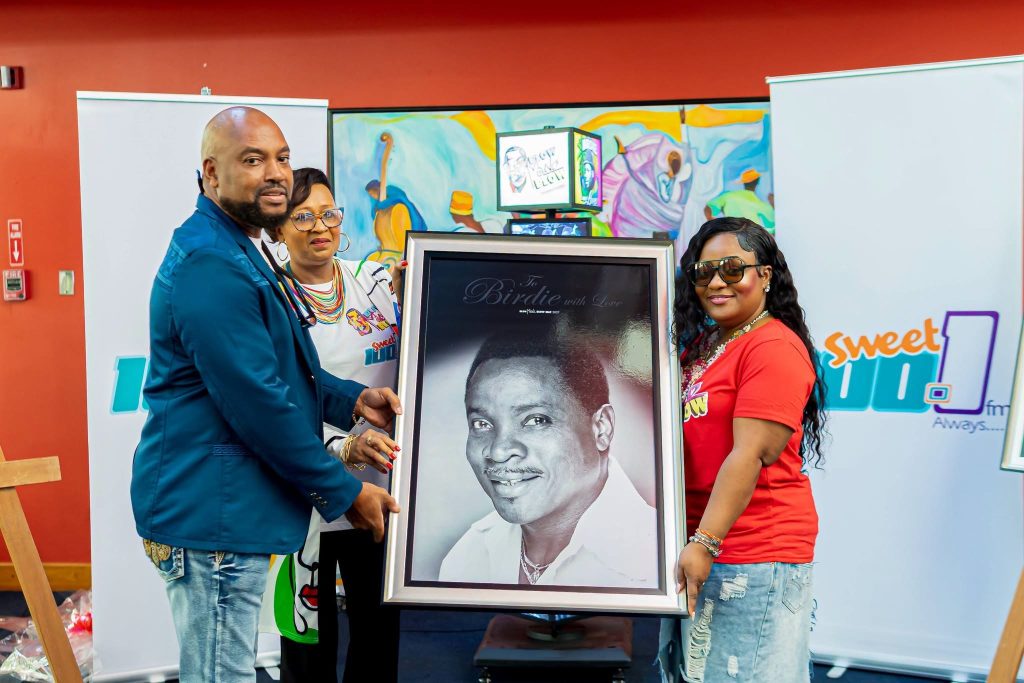
A private media launch to announce a partnership with Sweet 100FM, which took place back on August 24th at Queen’s Hall, saw The Mighty Sparrow’s daughter, Karen along with his daughter in music, Natasha Wilson, presented with portraits of the legendary artiste as tokens of the team’s appreciation. “When we spoke with Sparrow before the band launch, we told him the ideas for the band and he said, “I love it. I love it.” He also said the song, ‘Both ah Dem’ was one of his favorites after learning that KV Charles would be singing some of his songs at the band launch,” Marcellin revealed.
Saying Goodbye to a Legend with Honor.
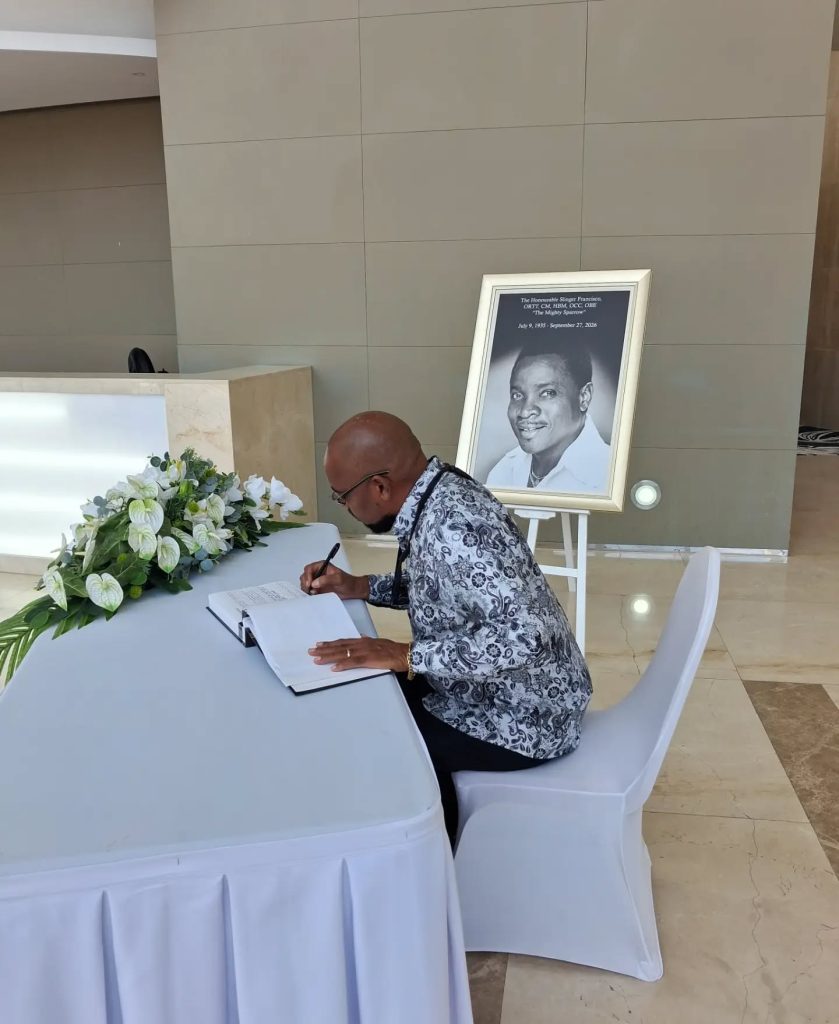
On Friday, October 16th, The Mighty Sparrow will be laid to rest. His state assisted funeral will begin with a procession from 10am from Independence Square in Port- of- Spain, moving along Frederick Street, before concluding at NAPA. The procession will include a National Farewell at Independence Square, a People’s and Cultural Farewell along Frederick Street, and a Ceremonial Farewell at NAPA. Burt Marcellin believes a lasting tribute to the Mighty Sparrow is necessary. “I was lucky to have seen Sparrow perform in 1996 for the first time live at a major event in Caribana – Sheraton. It was the biggest event in Caribana in those days and Sparrow opened the show. I have never seen anybody perform like that. He had the bacchanal vibe – a real performer, the way he commanded the crowd,” recalled Marcellin. With that memory fresh in his mind, Burt Marcellin says the youth of T&T stand to benefit immensely if programs are included in the education system that teach on his writing techniques, storytelling and melodies. I would also encourage consideration for his song, ‘Education’ to be played in all schools because it is a lesson for everyone. The value in those words should be used. The value lies in the staying power of his music. The fact that the melodies of Sparrow’s music can be hummed years after, is powerful,” emphasized Marcellin.
In September, when Burt Marcellin left Trinidad and Tobago on a brief trip to Miami, he took along with him, the portrait of the Mighty Sparrow that was initially presented to Natasha Wilson. Its size was a factor that affected her traveling to the US with it. “While en route to the post office with the portrait, in Miami, I received the call that he had passed away,” he recalled sadly. That was a moment that will undoubtedly stay with him.
In the words of Burt Marcellin- the son of the musical innovator, Mano Marcellin, “The Birdie was magnetic.” “He was very crafty with his words. He was a calypsonian and a writer, but he was also like an actor – he could communicate in all kinds of environments. His delivery, his execution – he was magnetic.”
The tributes to the Mighty Sparrow have not slowed. From across the region and internationally, the appreciation felt and the love expressed, has been deserving.”Ours was the last creative project that The Mighty Sparrow was involved in,” Marcellin said, putting into clear perspective the timing of everything and the immense privilege he had, to have engaged so happily with the Birdie, before he flew away.


-

 Ebuzz News1 day ago
The Mighty Sparrow: “The Birdie Will Be Flying High.” Burt Marcellin Recalls The Calypso King’s Words.
-

 Ebuzz News5 days ago
French Ambassador, Guillaume Pierre to Experience His First Ever Dîner en Blanc in Port-of-Spain, Trinidad.
-

 Ebuzz News1 hour ago
T&T’s Got Theatre and It’s Good! Best Little WhoreHouse in Guapo, Sensational.
Jo Wheeler
7th September 2024 at 8:42 PM
Another heartbreaking loss for the community.